
Patients sometimes see an injection and surgery as opposing camps – the “easy way out” versus the “real fix”. I’d frame it differently: they’re different tools for different jobs, and often the injection comes first for good reason.
A well-placed steroid injection can settle inflammation and, for plenty of problems, that relief holds. It’s quick, low-risk, and sometimes all that’s needed. Where it earns its keep even when relief is temporary is as a diagnostic clue – if it helps, even briefly, it confirms we’re targeting the right area.
When an injection’s benefit fades faster each time, that’s usually the joint telling us there’s a structural problem an injection can’t cure. That’s the point at which surgery, which addresses the cause directly, becomes the sensible next step.
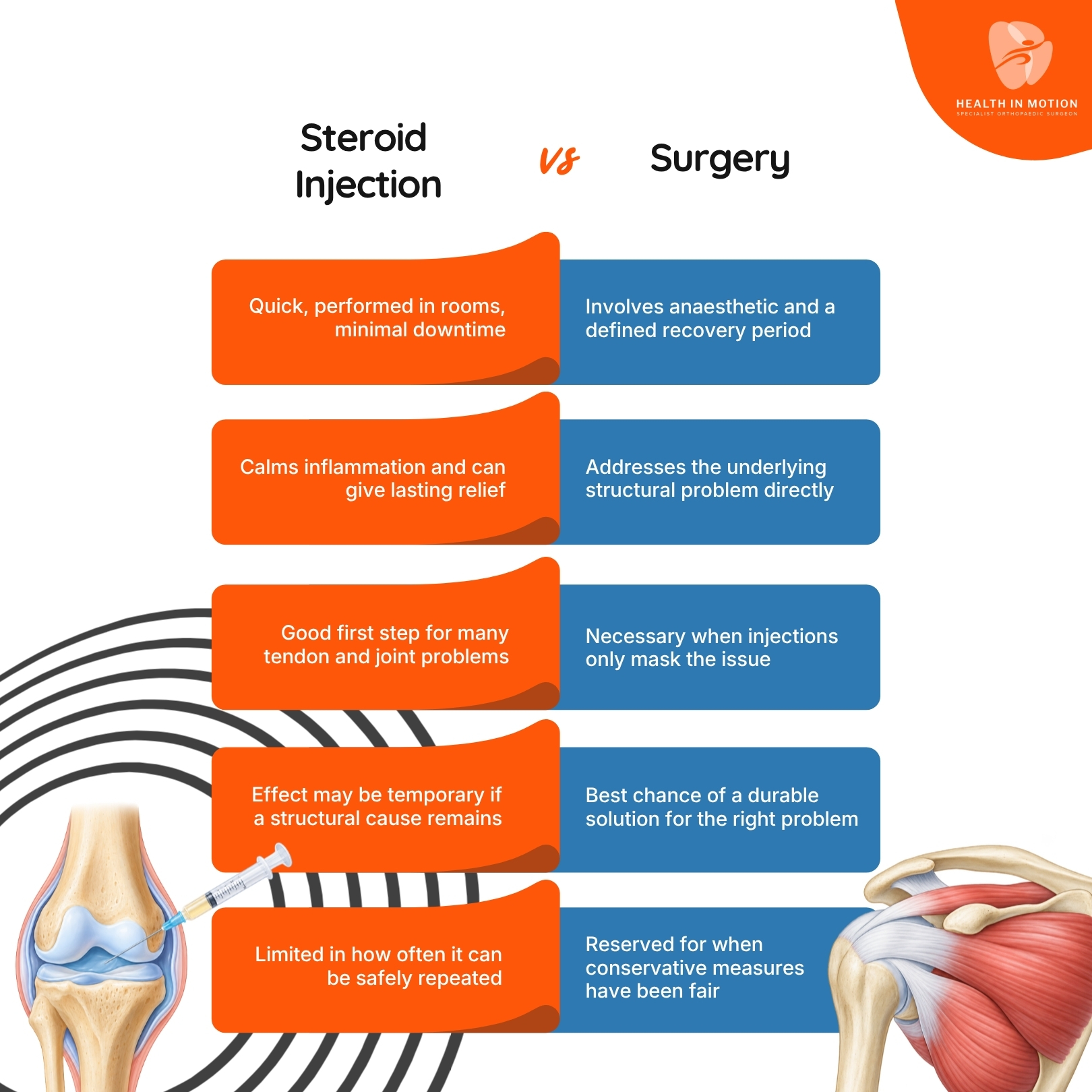
Steroid (Cortisone) Injection
- Quick, performed in rooms, minimal downtime
- Calms inflammation and can give lasting relief
- Excellent first step for many tendon and joint problems
- Effect may be temporary if a structural cause remains
- Limited in how often it can be safely repeated
Surgery
- Addresses the underlying structural problem directly
- Necessary when injections only mask the issue
- Involves anaesthetic and a defined recovery period
- Best chance of a durable solution for the right problem
- Reserved for when conservative measures have been fair